
Demand forecasting has always been a high-stakes balancing act: too much inventory erodes margins, while shortages impact revenue and customer trust. Traditional approaches based on historical data and spreadsheets often fail when market conditions shift. Today, AI enables organizations to move beyond static forecasting to real-time demand sensing by incorporating dynamic signals such as weather patterns, market events, and customer behavior.
Why traditional forecasting falls short
Heavy reliance on historical data and static models
Siloed, Excel-driven workflows across departments
Limited ability to incorporate real-time external signals
Reactive decision-making leading to stockouts or excess inventory
How AI transforms demand forecasting
AI transforms forecasting by integrating multiple internal and external demand signals:
Weather-driven demand sensing (hyperlocal conditions impacting buying behavior)
Event-driven spikes (sports events, travel, regional activities)
Social sentiment analysis to capture emerging trends
Supply chain signals to anticipate disruptions and material constraints
These capabilities enable predictive, adaptive, and scenario-based forecasting.
Practical AI adoption framework
Tier 1: Augmented forecasting - improves accuracy and planner productivity using AI insights.
Tier 2: Scenario-based planning - enables proactive decision-making through simulations.
Tier 3: Autonomous forecasting - drives real-time, automated supply chain responses.
Case study: AI-led supply chain transformation
A leading global food manufacturer faced fragmented systems, Excel-based planning, and lack of real-time visibility. Zensar helped transform the ecosystem through:
Process standardization across supply chain functions
Microsoft Dynamics 365-based unified platform
AI-driven forecasting using Microsoft Fabric and Power Platform
Today, AI enables organizations to move beyond static forecasting to real-time demand sensing by incorporating dynamic signals such as weather patterns, market events, and customer behavior.
Key outcomes

Accurate Forecasts
Forecast accuracy improved by 20 - 30%

Reduced Inventory
Inventory holding reduced by 15 - 25%

Improved Planning
Planning cycle time improved by ~30%

Increased transparency
Enhanced visibility and operational agility
Reference architecture: Microsoft-based AI forecasting
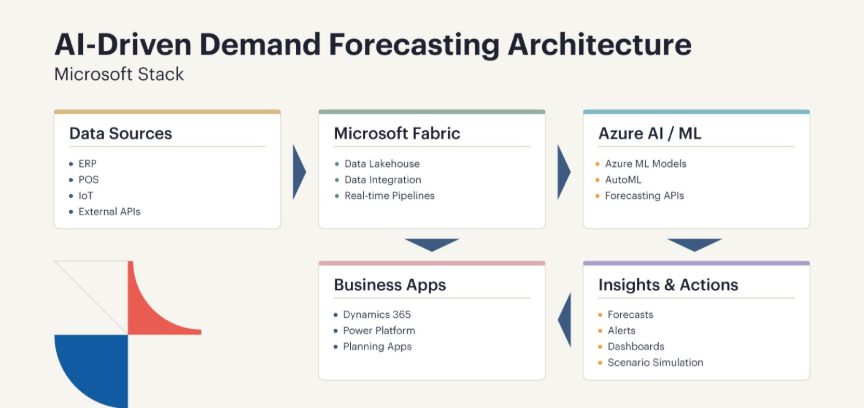
The architecture demonstrates how enterprise and external data sources are unified using Microsoft Fabric. Azure AI/ML models enable predictive insights, which are operationalized through Dynamics 365 and Power Platform to deliver forecasts, alerts, and scenario-driven decision support.
Why Zensar
Deep expertise across the Microsoft ecosystem (Dynamics 365, Fabric, Azure AI)
Industry-specific accelerators, enabling faster deployment
Strong focus on end-to-end transformation (process + platform + AI)
Proven experience across global supply chains
AI-driven demand forecasting enables organizations to move from reactive planning to predictive, data-driven decision-making. By combining real-time signals, advanced analytics, and automation, enterprises can achieve greater accuracy, agility, and resilience in their supply chains.
Connect with Zensar (msbizapps@zensar.com) to assess your forecasting maturity and define an AI-led transformation roadmap tailored to your business needs.