
Most large enterprises don't have a data shortage - they have a data agreement shortage. Sales, service, marketing and finance each hold a different version of the same customer, and every version is confident it's right. Salesforce Data 360, formerly Salesforce Data Cloud, is built to end that argument. Here is why it matters now, and what changes when it works.
The problem large enterprises keep re-solving
Every large organization eventually builds the same problem at scale: more systems than it can reconcile, and more customer truth than any one team can see.
Personalization breaks at the handoff - A marketing campaign, a service case, and a renewal conversation all reference the same person, but rarely the same facts. The customer feels the seams even when no single team makes a mistake.
AI is only as good as what it can see - An AI agent grounded in one system's partial view of a customer will confidently say the wrong thing. Fragmented data doesn't just slow people down - it now actively misleads automation. This is why organizations adopting Agentforce need trusted, unified customer data.
Integration cost compounds every year - Point-to-point integrations and nightly batch jobs multiply with every new system added, and every one of them is a future migration cost, not a one-time project.
What Data 360 actually does
Strip away the marketing layer and Data 360 is four disciplines, done consistently across the enterprise instead of once per department.
Connect - bring data in without moving it
Zero-copy access reaches Snowflake, AWS, Google Cloud and existing Salesforce clouds, so the source of truth stays where it already lives instead of being duplicated into yet another store. This supports enterprise Salesforce integration while reducing unnecessary data movement.
Harmonize - resolve identity across systems
Identity resolution and a shared data model turn five inconsistent customer records into one, reconciled automatically rather than through a quarterly data-cleanup project. The result is a unified customer profile that can be used across teams and workflows.
Engage - act on it in real time
Calculated insights and triggered flows let a change in customer behavior update a journey, a case, or a segment immediately, not at the next batch cycle.
Ground - give AI agents real context
Agentforce reasons over the unified profile directly, so an agent answering a customer or assisting an employee is working from the same facts a human colleague would see. This trusted context builds on the wider role of Salesforce Einstein in business operations.
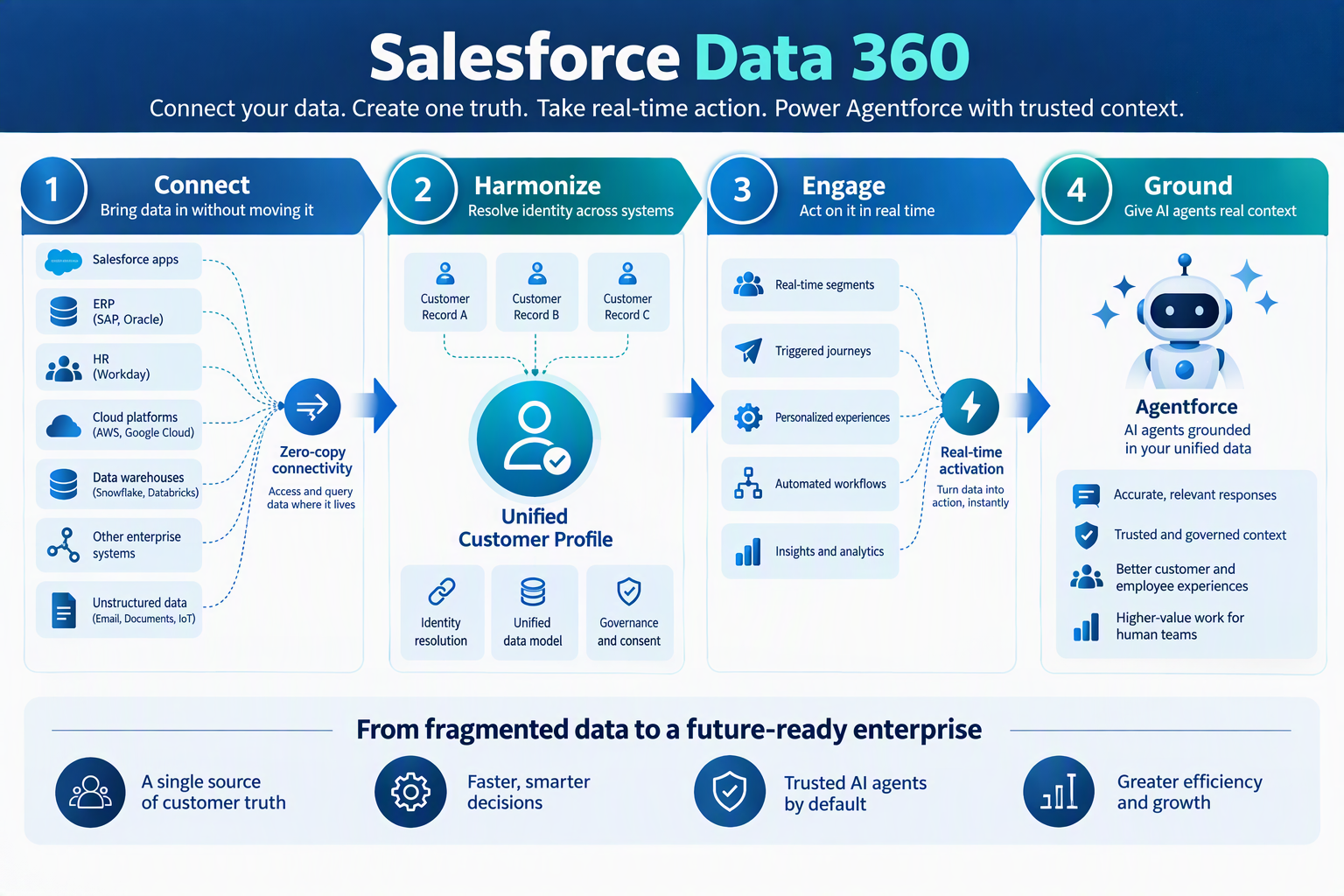
Where Data 360 sits in the landscape you already run
Nobody is buying Data 360 into a blank environment. It sits between the systems you already trust and the experiences your teams run every day - without replacing either.
Whatever combination you run - SAP or Oracle for ERP, Workday for HR, Salesforce for CRM, a separate SCM suite, Snowflake or Databricks for the warehouse - Data 360 reads from each through zero-copy connectors rather than requiring a migration. It becomes the layer that makes them agree with each other, and the layer everything above them draws from as a single source of truth.
Why 2026 is the inflection point, not just another upgrade year
Salesforce's move to fold Data Cloud into the broader Agentforce 360 platform is a signal, not a rebrand. Every recent release - expanded zero-copy connectivity, privacy-safe Clean Rooms for cross-company data collaboration, and deeper native grounding for Agentforce - treats unified data as the prerequisite for trustworthy AI, not an optional layer underneath it. The organizations that unify their data now are the ones whose AI initiatives will actually work in eighteen months; the ones that don't will spend that time discovering why their agents keep getting the customer wrong. Organizations planning this shift can work with a Salesforce consulting and implementation services to align data, integration, governance and AI priorities.
"Unified data makes AI smarter. Smarter AI makes agents more effective. More effective agents free up human teams to focus on higher-value work."
- Industry analysis of the Data 360 platform shift, 2026
What large enterprises gain
Personalization that survives the handoff
Marketing, sales and service work from one profile, so an offer, a case history, and a renewal conversation all agree with each other - the thing customers actually notice. This supports a unified sales, service and marketing experience using Salesforce.
AI agents that are trustworthy by default
Agentforce grounded in unified, governed data reduces the single biggest cause of AI failure in the enterprise: an agent confidently reasoning over an incomplete picture.
Lower integration overhead over time
Zero-copy connectivity replaces a growing web of point-to-point integrations with a single access layer, which shows up as avoided cost in every future system you add.
Governance and compliance built in, not bolted on
Consent, retention and access rules are enforced once, centrally - a materially different posture for regulated industries like insurance, healthcare and financial services than reconciling policy across a dozen systems. This is especially relevant for sector-specific Agentforce adoption, including Zensar’s participation in the Salesforce Agentforce Life Sciences Alliance.
Faster time from question to decision
Calculated insights and real-time triggers move analysis out of the monthly reporting cycle and into the moment a customer’s behavior actually changes.
Getting it right: our implementation approach
Data 360's biggest documented risk isn't the platform - it's under-scoped identity resolution and data modeling done without enterprise architecture discipline. This is where an experienced partner changes the outcome. A structured Salesforce Data 360 implementation approach helps connect the platform to measurable business use cases.
Assess
Map the real sources of truth
We inventory every system that claims to know the customer and identify which one should actually win when they disagree.
Architect
Design identity resolution and the data model
The part most implementations underestimate: matching rules, harmonization logic and governance are designed for your entities, not left as platform defaults.
Activate
Connect one high-value use case first
A single, measurable use case - a unified service view or a real-time segment - proves the model before it scales, instead of unifying everything at once and finding errors late.
Scale
Extend to Agentforce and the rest of the enterprise
Once the foundation is trusted, grounding AI agents and expanding to new business units is an extension of the model, not a rebuild of it.
Salesforce Data 360 and Agentforce FAQs
What is Salesforce Data 360?
Salesforce Data 360, formerly Salesforce Data Cloud, is Salesforce’s native data engine for activating trusted enterprise data across applications, workflows, analytics and AI agents.
How does Salesforce Data 360 support Agentforce?
Salesforce Data 360 gives Agentforce access to unified, governed customer and enterprise context, helping AI agents use relevant information across customer and employee interactions.
What is zero-copy integration in Salesforce Data 360?
Zero-copy integration allows Salesforce Data 360 to access supported external data without first duplicating it into Salesforce, helping organizations use data where it already resides.
How is Salesforce Data 360 different from a traditional customer data platform?
Salesforce Data 360 goes beyond marketing-focused customer data activation by connecting unified data with Salesforce applications, workflows, analytics and Agentforce.
What should enterprises assess before a Salesforce Data 360 implementation?
Enterprises should assess source systems, data quality, identity-resolution rules, consent, governance, integration patterns, priority use cases and success measures before scaling Salesforce Data 360.
See what your data actually looks like unified
We'll walk through your current systems, show where identity resolution would have the biggest impact, and scope a first use case you could have live within a quarter.
Explore Zensar’s Salesforce Implementation Partner for consulting, implementation, integration, Data Cloud, Agentforce and managed services.