
Every Order starts perfect. Many don't stay that way.
More orders encounter operational disruptions between order creation and shipment than most retailers would care to acknowledge. A carrier doesn't respond for 72 hours, a customer enters a building number that doesn't exist, inventory runs out, and payment does not clear. Each of these looks like it can be fixed quickly. But real problems arise at scale across thousands of daily orders, peak seasons, and a dozen fulfillment facilities. At scale, these exceptions become one of the largest cost drivers in day-to-day retail operations.
A modern Order Management System (OMS) isn't about how it handles an order; it's how intelligently and quickly it responds when the order doesn't go according to plan and before it becomes a customer problem.
What goes wrong: The exception classification
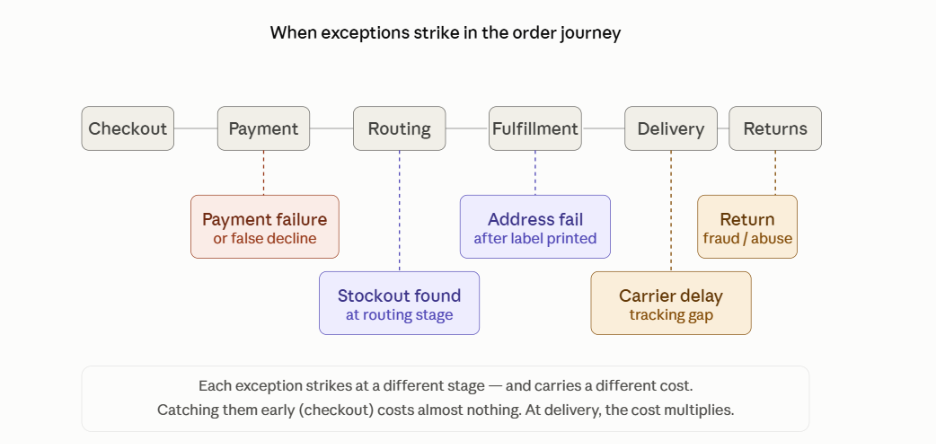
The flowchart above shows the most commonly discussed exception. Let's check and discuss a few unique exceptions that modern OMS handles.
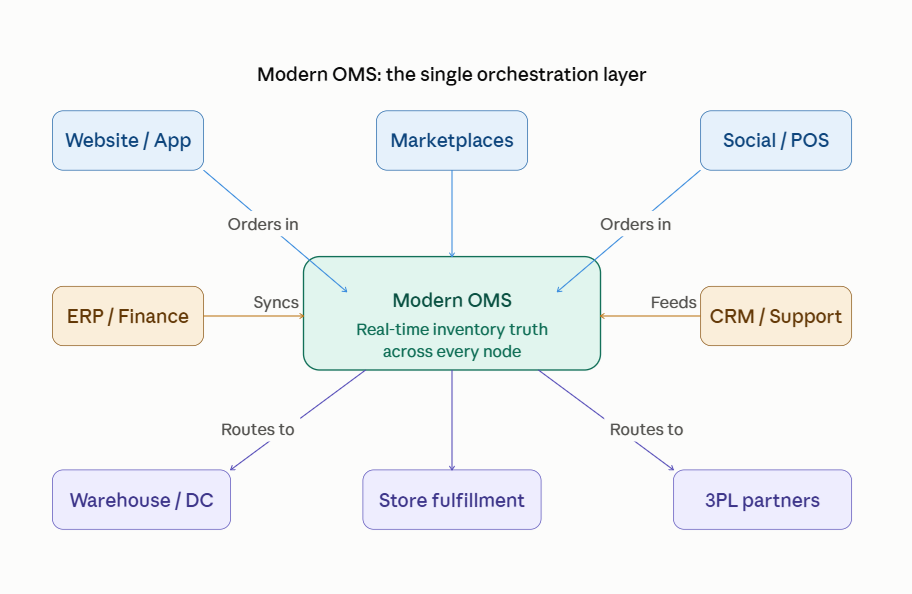
Real-time inventory updates: A modern OMS provides a unified, real-time view of inventory across distribution centers, stores, and virtual inventory pools. This visibility enables retailers to optimize distributed inventory, improve fulfillment decisions, and meet customer demand more effectively across channels and geographies.
During modernization initiatives, many retailers operate legacy and modern OMS platforms in parallel while transitioning from one system to another. To ensure business continuity, modern OMS platforms seamlessly integrate with legacy systems, enabling efficient management of shared inventory, synchronized events, and consistent order orchestration across the enterprise.
Customizability of modern OMS: To meet different retailers' needs, modern OMS must be highly customizable. Modern OMS also offers the advantage of managing standard out-of-the-box (OOTB) OMS behavior. OOTB examples include managing credit card payments and failures, timing order releases to WMS, and nested exchanges.
Fraud detection: An order flags as fraudulent and enters manual review. The hold might be correct, or it might be applied incorrectly to a loyal customer, who is growing frustrated. Without smart scoring, the review queue becomes a customer satisfaction liability. Rather than sending every flagged order to a human queue, modern OMS auto-approves low-risk holds and escalates only genuinely suspicious orders, keeping the queue lean and actionable.
Split shipment and partial fulfillment: A multi-item order can't ship completely because stock is distributed across facilities or inventory is short. A modern OMS must decide efficiently whether to short and cancel, short and reallocate, split, delay, or substitute, and communicate its decision clearly. Handling short and reallocate requires significant technical detail, as it touches core OMS functionality like allocation and payment. This makes implementation challenging; however, modern OMS handles it smoothly. If not handled properly, this creates customer confusion and leaves customers feeling they ordered one thing and received something else entirely.
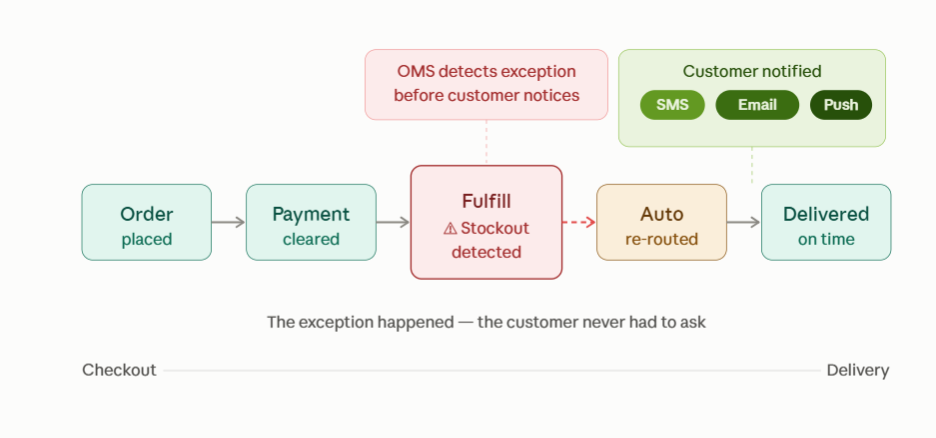
What sets modern OMS apart?
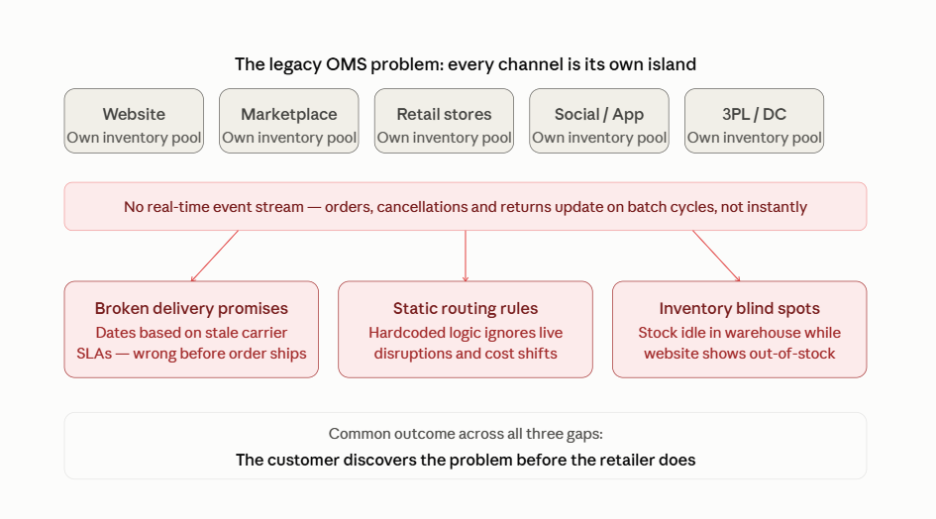
Legacy order management systems were built to process the happy path efficiently. Exception handling was typically a manual workflow.
Modern OMS architecture inverts this entirely. Rather than treating exceptions as something to clean up after, the system is designed to anticipate, detect, and resolve them before the customer notices anything is wrong.
Analyzing exception data: An OMS that resolves exceptions is a strong sign. Modern OMS uses exception history data to prevent the same exceptions from recurring. This makes a huge difference. This helps retailers reduce customer churn and achieve measurably higher repeat purchase rates. Consider a retailer processing 10,000 orders a month with a 5% payment exception rate; that's 500 disrupted orders monthly. Addressing even half through proactive exception handling recovers hundreds of orders that would otherwise have been silently lost.
Effective customer communication: Where automatic resolution isn't possible, modern OMS triggers proactive communication before the customer reaches out. In scenarios like payment failures, ship-and-short issues, and ETA changes, effective communication builds customer trust and helps retailers resolve exceptions before they become customer complaints.
Modern OMS: Pioneering the next era
In retail operations, exceptions aren't a possibility - they're a certainty. What matters is how early an exception is detected and handled gracefully, rather than detected late and noticed. With a modern OMS, the gap between detecting an exception and resolving it is seconds, not hours. This is the real deciding factor.
The industry data reflects this urgency. While a precise migration figure is hard to pin down, the signal is clear: over half of retailers are actively dissatisfied with their legacy OMS; investment in order orchestration is surging. The modern OMS market is on track to nearly triple by 2034. The shift is not a question of if, but how fast.
Zensar combines deep retail and supply chain expertise with extensive experience implementing Manhattan solutions for leading global retailers. By leveraging Manhattan's modern cloud-native Order Management capabilities, organizations can improve inventory utilization, optimize fulfillment, enhance customer experiences, transform exceptions into learning opportunities, and build more resilient supply chains prepared for the future.