
"Most Order Management System (OMS) selections start with a demo and end with a feature comparison. Retailers ahead of the curve start somewhere different: with a clear answer to what their fulfillment operation needs to become, not just what it needs to do today."
Drawing on the experience of supporting OMS transformations across global retail organizations, Zensar has observed a consistent pattern: the difference between OMS investments that transform businesses and those that simply replace legacy systems rarely comes down to features. It comes down to strategic clarity about what your fulfillment operation must become in three years, where gaps are costing your customers today, and what measurable success looks like 18 months post go-live.
What retailers get wrong in OMS evaluations
The most common OMS selection mistake is treating the process as a procurement exercise, scoring feature checklists and negotiating commercial terms, only to discover 12 months into implementation that the platform can't support the fulfillment models needed two years from now.
The most damaging patterns our experts consistently observe include prioritizing current-state features over future scalability; underestimating integration complexity with ERP, WMS, and eCommerce systems; failing to define measurable business outcomes before evaluating platforms; and overlooking change management. The platform is 40% of the challenge; the organization is 60%.
The Zensar perspective: Retailers that achieve the fastest time-to-value from OMS investments spend the most time defining outcomes before opening a vendor conversation. When you know exactly what you're evaluating, platform selection becomes significantly clearer.
Understanding OMS maturity: Where are you and where do you need to be?
Most retailers believe they're operating at a higher maturity level than their platforms actually support.
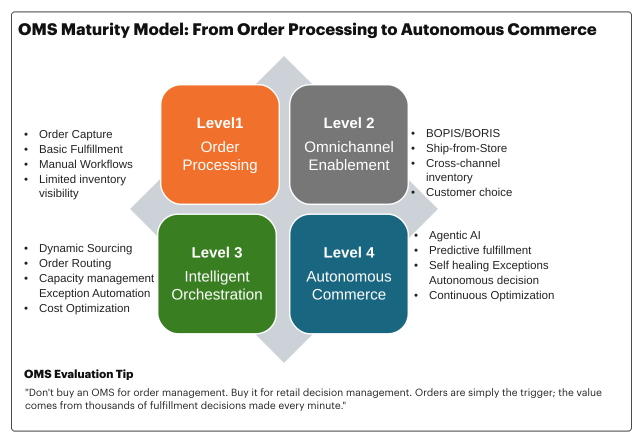
Understanding OMS maturity
Organizations typically progress through four stages of OMS maturity:
Level 1: Order processing focuses on transactional execution and basic workflow fulfillment.
Self-check: Can your team describe your fulfillment logic without saying "it depends"?
Level 2: Omnichannel enablement unifies inventory visibility and customer-centric fulfillment: Buy Online, Pickup In Store (BOPIS), Buy Online, Return In Store (BORIS), Ship-from-Store.
Self-check: Do you know the cost and margin of every fulfillment path in real time?
Level 3: Intelligent orchestration leverages advanced sourcing, routing, capacity management, and exception automation to optimize fulfillment performance.
Self-check: Can your OMS make a better fulfillment decision than your most experienced operator?
Level 4: Autonomous commerce uses agentic AI, predictive analytics, and self-healing workflows to optimize fulfillment decisions with minimal human intervention continuously.
Self-check: Is your OMS getting smarter every day or just processing faster?
The critical question is not where you are today. It is whether your OMS can support the next stage of maturity, and the one after that.
Capabilities that actually matter
1. Unified Inventory Visibility
Most retailers don't have an inventory shortage problem; they have an inventory truth problem. Inventory exists in the network, but if you can't determine what's available, where it is, and whether you can profitably fulfill it, it creates no value. A modern OMS must deliver real-time visibility, Available-To-Sell (ATS) calculations, and dynamic allocation. Data quality is foundational: the most sophisticated OMS cannot compensate for inventory records that are 85% accurate.
2. Omnichannel fulfillment execution
About 87% of retailers now offer BOPIS, and 59% of consumers expect it as baseline. But adoption has outpaced capability, as many offer the option without the ability to fulfill it profitably and consistently across all locations. The OMS must orchestrate BOPIS, BORIS, Ship-from-Store(STS), Same-Day Delivery(SDD), and cross-channel exchanges, not just route orders but make the right routing decision every time.
3. Intelligent order orchestration
Modern supply chains require orchestration that evaluates inventory availability, delivery promises, carrier options, fulfillment costs, and capacity constraints in real time. According to MIT's Center for Transportation and Logistics (2025), 60% of organizations identify order fulfillment as one of the areas most impacted by eCommerce growth, reinforcing the urgency of getting orchestration right.
4. Proactive exception management
Inventory shortages, payment failures, and carrier delays are not edge cases. They are daily operational realities. A mature OMS proactively detects exceptions, automates resolution workflows, and communicates with customers before they ask. The difference between reactive and proactive exception management shows up directly in customer satisfaction and repeat purchase rates.
5. AI and Automation readiness
The next generation of OMS moves beyond rule execution toward autonomous decision-making. Predictive inventory management, intelligent exception resolution, and Agentic AI-powered orchestration are current differentiators, not future capabilities. When evaluating platforms, ask not only what AI capabilities exist today, but also how the platform's AI learns and improves your operational data over time.
What the right platform looks like: The Manhattan Active Omni OMS difference
The right question when evaluating an OMS is no longer "Can it process orders efficiently?" It is now: "Can the platform intelligently orchestrate fulfillment decisions as conditions change and get smarter over time?"
Manhattan Active Omni OMS addresses this directly. Recognized as a 2025 Forrester Wave Leader, it dynamically evaluates cost, capacity, proximity, and delivery commitment across the fulfillment network. Optimization isn't a one-time configuration. The platform continuously improves decisions as demand patterns, network constraints, and inventory positions shift. Customers receive post-purchase flexibility, including order tracking, returns, exchanges, and in-progress modifications through digital self-service, which has moved from a loyalty differentiator to a baseline expectation.
The future of order management is not just knowing where inventory is. It's knowing what to do with it and executing that decision faster, more accurately, and more profitably than any manual process can.
Why the partner defines the outcome
Selecting the right OMS is only the first step. Success depends on seamlessly integrating it with ERP, WMS, eCommerce, and customer experience platforms, and on enabling meaningful operational change across fulfillment, store, and service teams. Through Zensar's partnership with Manhattan Associates, clients benefit from a market-leading OMS backed by deep retail transformation expertise, including optimized inventory management, streamlined workflows, empowered teams, and a scalable foundation for growth.
Talk to Zensar about your OMS transformation journey.
zensar.com | In partnership with Manhattan Associates