
Why the implementation partner matters more than the license
Buying Salesforce licenses is the easy part. The platform's real value, i.e., a storefront that converts and a support desk that resolves issues on first contact, depends almost entirely on who implements it. Commerce Cloud and Service Cloud often under-deliver when the Salesforce Services engagement is treated as a technical rollout rather than a business transformation. This article explains how each cloud applies, what a sound approach looks like, and what to ask before signing with a partner, using Zensar, a Salesforce Summit Partner, as an example.
Salesforce Commerce Cloud: Turning storefronts into growth engines
Salesforce Commerce Cloud is Salesforce's digital commerce platform, built to run B2C and B2B storefronts on a shared foundation. It brings together catalog and price management, promotions, and order management. It connects to Salesforce's Customer 360 data model so a purchase, a service case, and a marketing touchpoint can sit on the same record. Salesforce continues extending the platform with headless capabilities for B2B and composable, API-first building blocks for B2C, reducing reliance on a single front-end template. In practice, manufacturers that sold only through reps want a self-serve storefront for repeat orders; retailers want AI-assisted recommendations; and multi-brand businesses want one platform running several sites without duplicating infrastructure.
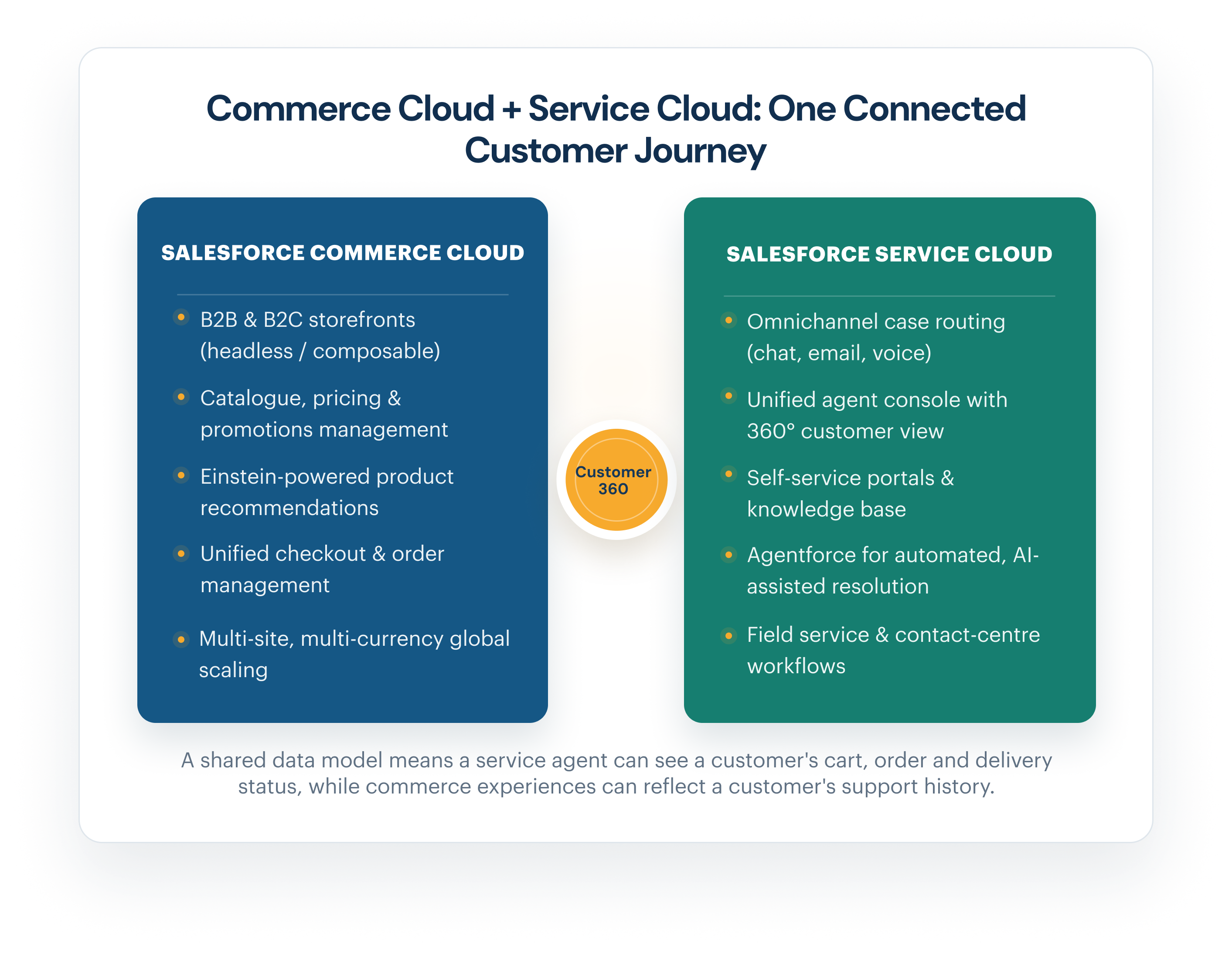
Figure 1: Commerce Cloud and Service Cloud can share one customer data model inside Salesforce.
Where Commerce Cloud can deliver value
B2B self-service portals: Buyers self-serve routine orders online, freeing sales reps for larger accounts.
Rapid merchandising: Retailers use Einstein-powered recommendations to react to demand shifts.
Unified checkout: A consistent checkout across channels can help reduce cart abandonment.
Global scale: Multi-site and multi-currency management serves several countries from a shared catalog.
Two public examples: For a US-based medical device company, Zensar combined Experience Cloud and Commerce Cloud to open its first regional eStore. For a toy manufacturer, Zensar added a credit-pay option via Salesforce Order Management, which it reported contributed to a 20% boost in online sales.
Salesforce Service Cloud: Service experiences customers can trust
Salesforce Service Cloud is the customer-service side of the platform. At its core is case management: an inquiry becomes a trackable case with history and context. Around that core, Service Cloud adds omnichannel routing to the right agent, a unified agent console, self-service portals, and increasingly Agentforce, Salesforce's AI layer for case summarization and assisted resolution. Because Service Cloud can share a data model with Commerce Cloud, an agent can potentially see the same order history a commerce team sees, reducing repeat explanations, provided the integrations are built to support it.
Where Service Cloud can deliver value
Faster case resolution: Automated routing cuts manual triage and directs inquiries to the right resource.
Contract lifecycle visibility: Contract tracking moves from spreadsheets to an automated, auditable workflow.
Compliance-ready automation: Workflow automation can support obligations such as GDPR while shortening release cycles.
Connected field operations: Field teams get one mobile-ready system for scheduling, dispatch, and job history.
Three examples: For Hawai'i Gas, Zensar implemented Industry Cloud with DocuSign for contract lifecycle management. For a UK banking client, GDPR-aligned workflow automation paired with DevOps automation to speed releases. For a coding and marking solutions manufacturer, a global Salesforce CPQ rollout reportedly contributed to a 25% shorter sales cycle and a 50% improvement in combined retention and satisfaction.
Professional services: Where the right approach makes the difference
Commerce Cloud and Service Cloud are powerful, but neither delivers value by default. The professional-services methodology, including discovery, how much is configured versus custom-built, testing, and what happens after go-live, is usually the real differentiator between a Salesforce investment that pays off and one that stalls.
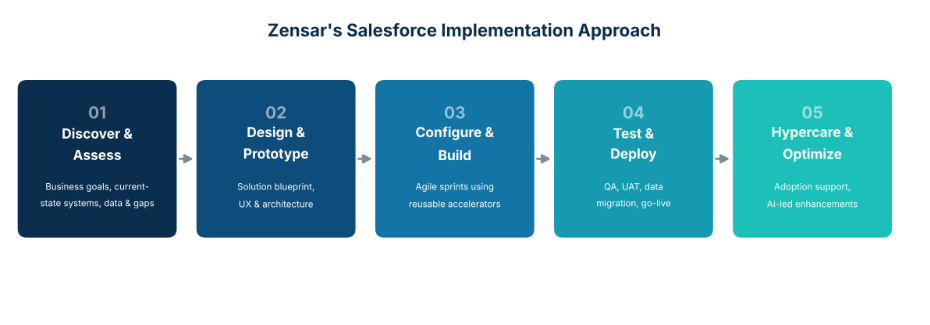
Figure 2: A five-stage implementation approach keeps scope, risk, and adoption under control.
Zensar structures engagements around a staged approach that pairs industry-experienced domain consultants with certified architects, aiming to avoid a common failure: correct configuration that doesn't match how an industry's processes work. Zensar's Salesforce Center of Excellence has described solution sets for financial lending, retail loyalty, and field workforce management, alongside an Agentic Deployment Framework with 25-plus cross-SaaS agents and accelerators.
How to choose the right Salesforce partner
With hundreds of Salesforce consulting partners in the market, the choice usually comes down to a short checklist:
Partner tier and certifications: Look for Salesforce Summit or comparable-tier status, and ask how many certified architects will actually be staffed on your project.
Proven, relevant case studies: Ask for case studies in your industry and cloud with outcomes you can verify, not generic claims.
Accelerators over custom-build-everything: A partner using pre-built accelerators should offer a shorter, lower-risk delivery timeline.
AI and Agentforce readiness: Confirm the partner has a defined practice for Agentforce and AI-assisted service.
Post-go-live support model: Managed services, hypercare, and ongoing optimization should be part of the proposal, not an afterthought.
Why this matters Independent analyst recognition is a useful signal: Zensar was recognized in Gartner's 2018 Market Guide for Salesforce Implementation Services, covering CRM and CX consulting across sales, service, and digital commerce. Weigh it alongside current, verifiable case studies. |
|---|
The Zensar advantage
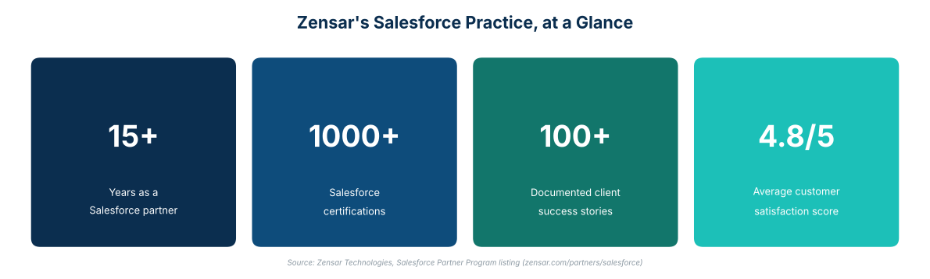
Zensar has been a Salesforce partner for more than 15 years and holds Salesforce Summit Partner status, the platform's highest tier, with more than 1,000 Salesforce certifications and over 100 documented client success stories across Commerce, Service, Sales, Field Service, and CPQ.
For organizations evaluating a Commerce Cloud or Service Cloud implementation, the practical question is what a partner has actually delivered, in an industry like yours, with a methodology you can inspect. Zensar's publicly documented client work, from B2B commerce portals and regional eStores to contract-lifecycle transformation and CPQ-led sales redesign, gives a checkable basis for that evaluation.
Getting started
Whether the goal is a new B2B storefront, a modernized contact center, or a full commerce-plus-service transformation, the conversation should start with the business outcome, not the feature list. A practical discovery phase maps current-state systems against the target outcome, followed by a scoped proposal naming accelerators, team, and timeline.
Salesforce Commerce Cloud and Service Cloud FAQs
What is the difference between Salesforce Commerce Cloud and Service Cloud?
Commerce Cloud supports digital storefronts and B2B or B2C buying journeys. Service Cloud supports case management, omnichannel support, and field service. Both can share the same Salesforce customer data model.
Can Salesforce Commerce Cloud support both B2B and B2C businesses?
Yes. Commerce Cloud runs B2C and B2B storefronts on a shared foundation, including headless and composable options for more front-end flexibility.
How does Salesforce Service Cloud improve customer service?
It centralizes cases, automates routing across channels, gives agents a unified customer view, and increasingly uses Agentforce for AI-assisted case summarization.
What should a company look for in a Salesforce implementation partner?
Partner tier and certifications, verifiable case studies, reusable accelerators, AI readiness, and a clear post-go-live managed-services model.
Why do Salesforce Commerce Cloud and Service Cloud projects underperform?
Most commonly, because the engagement is run as a technical exercise rather than a business transformation, with too little attention to discovery, process fit, and change management.
What is Salesforce Agentforce and how does it relate to Commerce and Service Cloud?
Agentforce is Salesforce's AI agent layer. In Service Cloud, it assists case summarization and resolution; in Commerce Cloud, Einstein AI supports recommendations and personalization.
What happens after a Salesforce Commerce Cloud or Service Cloud go-live?
Expect hypercare support, release management, adoption monitoring, and a prioritized optimization roadmap rather than a team that disbands at go-live.
About Zensar
Zensar Technologies is a global digital solutions and technology services company and a Salesforce Summit Partner, helping enterprises modernize their Commerce Cloud, Service Cloud, and broader CRM landscape.