In today’s digital-first world, IT support and data operations are no longer just back-office functions - they are strategic enablers of business agility and innovation. Yet, many organizations struggle with fragmented processes, duplicate incidents, and outdated tools that slow down issue resolution and compromise data quality. This is where Zensar’s One Support DataOps comes in, transforming the way enterprises manage IT support and data operations.
What is One Support DataOps?
Developed by Zensar Technologies, One Support DataOps is a next-generation approach that combines AI, ML, generative AI, and automation to deliver a unified execution model for IT support and data operations. Its goal is simple: increase accountability, improve efficiency, and reduce operational costs.
Key benefits
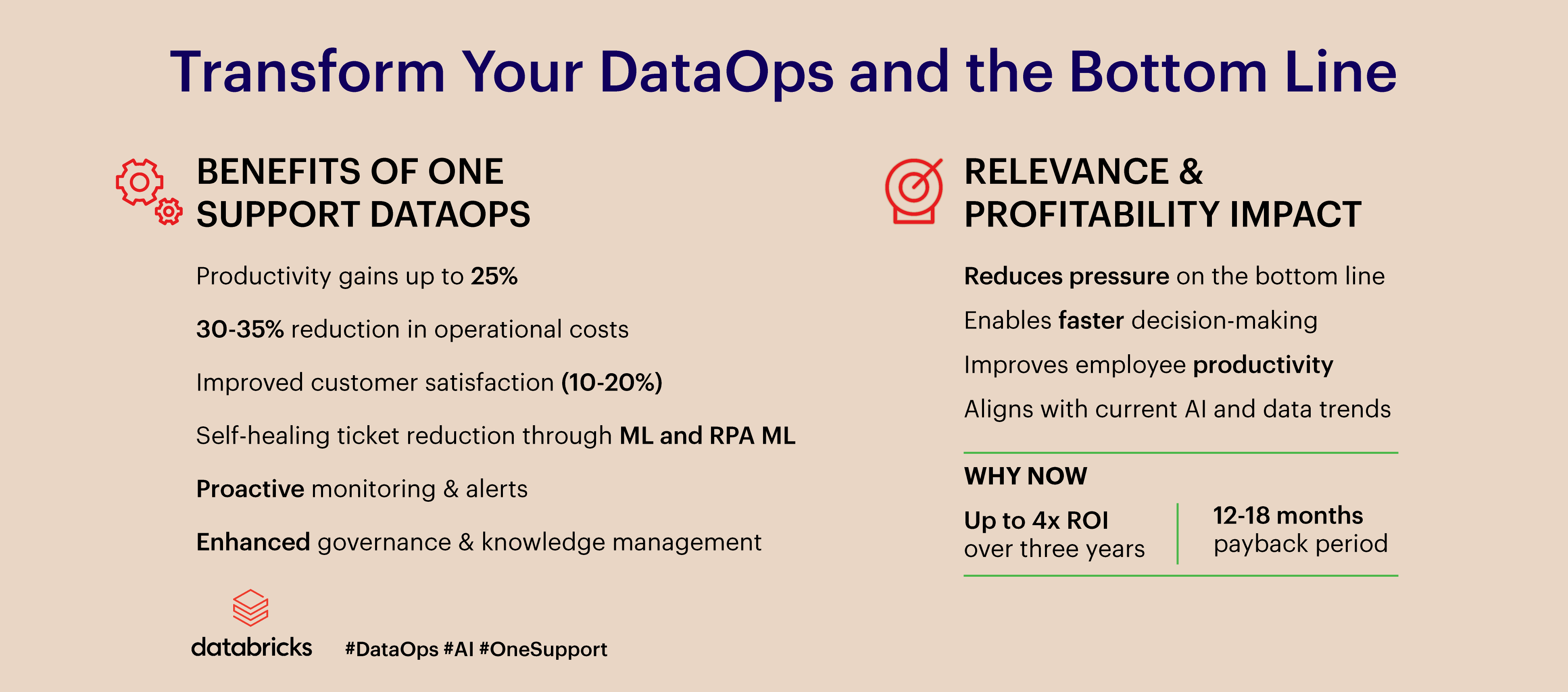
With One Support DataOps, organizations can realize productivity gains of up to 25% by streamlining processes and leveraging automation to reduce manual effort. These efficiencies are further reinforced by a 30 - 35% reduction in operational costs, achieved through the elimination of duplicate tasks and workflow optimization. Customers benefit directly from these improvements, experiencing a 10 - 20% increase in satisfaction thanks to faster issue resolution and proactive alerts that keep them informed. The platform also minimizes repetitive incidents through self-healing ticket reduction powered by machine learning and robotic process automation, ensuring smoother operations. In addition, proactive monitoring and intelligent alerts enable early detection and resolution of potential issues before they escalate. Finally, enhanced governance and knowledge management, driven by AI-based frameworks, empower smarter decision-making and strengthen organizational resilience.
Why this matters for organizations
Modern enterprises face increasing pressure to achieve more with fewer resources, balancing the need to optimize operations while continuing to drive innovation. One Support DataOps helps organizations meet this challenge by directly impacting the bottom line. By lowering operational costs and reducing outages, it eases P&L pressure and delivers significant savings. At the same time, faster resolution and improved data quality accelerate analytics and decision-making, enabling businesses to bring products and services to market more quickly and effectively. Additionally, automation frees skilled employees from repetitive tasks, allowing them to focus on higher-value work and boosting overall productivity across the enterprise.
Why now?
The timing for One Support DataOps could not be better. Organizations today are grappling with an explosion of data and rising complexity, as information pours in from multiple sources, making an integrated DataOps approach not just valuable but essential. At the same time, AI and automation technologies - particularly generative AI and machine learning - have reached enterprise maturity, enabling predictive and proactive support capabilities that were previously out of reach. Economic pressures further heighten the urgency, with CIOs and CFOs in 2025 prioritizing cost optimization and seeking solutions that deliver measurable improvements to the P&L. Adding to this momentum, cloud and Lakehouse platforms such as Databricks have matured significantly, providing the ideal foundation for scalable, automated DataOps that can transform enterprise operations.
Why Databricks is the ideal platform
Databricks provides a unified Lakehouse architecture that combines data engineering, analytics, and machine learning on a single platform. This makes it the perfect foundation for implementing DataOps principles and supporting Zensar’s One Support DataOps.
How Databricks enables DataOps
Databricks strengthens the implementation of DataOps by offering a unified data and AI platform that seamlessly integrates data ingestion, transformation, and analytics with machine learning workflows. At the core of this reliability is Delta Lake, which ensures data integrity across pipelines through ACID transactions. Deployment is accelerated with built-in automation and CI/CD capabilities, including Infrastructure-as-Code support that streamlines operational processes. To maintain trust and transparency, Databricks enforces governance and lineage tracking through Delta Live Tables and Unity Catalog, ensuring high data quality and observability. Its scalable architecture, powered by autoscaling clusters, enables enterprises to efficiently manage and process large volumes of data without performance bottlenecks. Finally, Databricks integrates with generative AI to drive intelligent automation, supporting anomaly detection and proactive data quality management that keeps operations resilient and future-ready.
The Synergy: Zensar + Databricks
When combined, Zensar’s One Support DataOps and Databricks deliver:
End-to-end visibility
From IT support tickets to data pipelines, everything is monitored and optimized.
Faster time-to-insight
Automated workflows and proactive alerts reduce downtime and accelerate analytics.
Cost efficiency
Unified governance and automation minimize operational overhead.
Future-ready operations
Generative AI and advanced automation prepare organizations for the next wave of data innovation.
From chaos to clarity
Enterprises that adopt Zensar’s One Support DataOps on Databricks gain a competitive edge by turning data chaos into clarity. They achieve higher productivity, lower costs, and improved customer experience, all while building a resilient, scalable data ecosystem.