
The wrong question
Ask anyone working in cybersecurity today, and they'll tell you the same thing: the industry has split into two camps. On one side, vendors claim their AI tools can replace human pentesters entirely. On the other hand, veteran security teams insist that nothing can replace hard-won human intuition. Both sides make valid points - and both are missing something important. At Zensar, we stopped asking 'AI or humans?' a while ago. The more useful question is: how do we get the best from both?
Our approach: AI that works alongside humans
We didn't build an AI product and then hire people to validate its output. We started by understanding how real penetration testing actually happens - the planning, the rabbit holes, the moments when something doesn't add up - and identified where AI genuinely helps and where it gets in the way. Think of it as having a capable co-driver on a long race. The AI handles navigation, tracks conditions, and monitors everything simultaneously. The human driver makes the judgment calls when the map doesn't match the road. Neither one works as well without the other.
Three ways we integrate AI into testing
1. Reconnaissance and discovery at scale (Strix AI)
The first task our AI handles is attack surface mapping. Strix AI runs automated reconnaissance, scans continuously, and flags vulnerabilities across large environments much faster than any human team could. For a small application, we've seen it complete full scans in about seven hours - work that would typically take a human tester two to three days. That said, speed comes with trade-offs. Strix does a solid job of identifying known vulnerability patterns, but it doesn't always surface everything. Business logic flaws, chained vulnerabilities, and application-specific quirks often require a human tester who can interpret context and adapt. The AI gets us to the starting line faster; our testers take it from there.
Where our human testers pick up the slack
Reading application behavior in context, not just pattern-matching against known CVEs
Deciding which AI findings truly matter to the client's risk profile
Exploring unusual behaviors, Strix flags them but doesn't fully investigate
Planning multi-stage attacks that require chaining weaknesses together
📊 Evidence: Strix AI in action
The screenshot below shows a real Strix AI pentest run on a small application. The full scan completed in approximately seven hours - compared with the two to three days a manual tester would need to cover the same ground.
Important note on coverage: While Strix AI significantly reduces the time burden, it doesn't catch everything. The automated scan did not flag business logic flaws, privilege escalation chains, and context-dependent authentication issues. Our manual testers identified them during the follow-up phase. This is exactly why we treat Strix AI as a starting point, not a finish line.
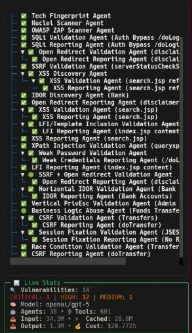
Strix AI scan output - small application - ~7 hrs completion time
2. Targeted testing with precision (BurpAI + manual expertise)
Once Strix has mapped the attack surface, we shift to more targeted testing using BurpAI alongside our testers. BurpAI handles the repetitive work - generating payloads, analyzing request and response patterns, and filtering false positives. Our testers focus on what's actually interesting: business logic, unusual authentication flows, and endpoints that don't quite behave as expected.
🔍 Real impact
One recent engagement uncovered 23 vulnerabilities through automated scanning. The one that mattered - a business logic flaw that could have enabled over $2 Mn in fraudulent transactions - was found by a tester who noticed the application behaved differently depending on session state. The AI flagged the anomaly; the human understood what it meant.
3. Reporting that actually gets read (Claude integration)
Pentest reports are notoriously poor. Dense, technical, and inconsistently formatted, they often sit unread on a shared drive until something goes wrong. We use Claude to generate initial drafts that translate technical findings into plain English, suggest code-level fixes, and produce executive summaries that non-technical stakeholders can actually act on.
Our experts then review and tailor every report - adding strategic context, reprioritizing based on the client's tech stack and threat model, and validating the AI's suggested remediations. What used to take three days now takes four hours, freeing our team to focus more on actual testing.
Why both camps get it half right
The AI-first camp has a point: manual-only testing doesn't scale, it's expensive, and individual tester quality varies. Automating the repetitive, coverage-heavy work makes sense.
The manual-first camp also has a point: current AI tools, when run in isolation, produce noisy results, miss complex logic flaws, and can't think adversarially in novel situations. A high false positive rate creates more work for an already-stretched security team.
Both camps go wrong by treating this as an either/or choice. The cases where AI falls short are exactly the cases where experienced testers shine - and the cases where manual testing is slow and expensive are exactly where AI can take the load.
Five reasons the hybrid approach works
10+ Applications scanned simultaneously | 40% Cost saving vs. manual-only |
7 hours Strix AI scan time for a small app | 4 hours Report generation (was 2 days) |
95% Reduction in false positives | 2-3× More coverage in the same timeframe |
Breadth plus depth.
AI covers everything. Humans cover what matters most. Neither compromise is necessary.
Speed without cutting corners.
Automation takes repetitive work off our testers' plates, freeing them to focus more on complex problems that require human judgment.
Each engagement gets smarter.
Human findings feed back into tuning our AI models. AI-discovered patterns inform testers' approach to new engagements, compounding over time.
Far fewer false positives.
AI flags candidates; humans validate with context. We've seen 90%+ reductions in false-positive rates when the two work together.
Better value.
Clients get faster timelines, broader coverage, and sharper analysis, typically at a lower total cost than either pure-AI or pure-manual alternatives.
Tools we use and what they're good for
Strix AI
Attack surface reconnaissance and vulnerability scanning at scale. Fast and broad, but not exhaustive by design.
BurpAI
Context-aware payload generation and intelligent request analysis during targeted testing phases.
Claude Integration
Drafting, summarizing, and translating technical findings into accessible language for diverse audiences.
Our certified testers (OSCP, OSWE, GXPN) work within a proprietary orchestration layer that integrates these tools with human workflows, so findings don't get lost between systems, and every engagement benefits from accumulated knowledge.
Where this is headed
We expect AI to handle most of the repetitive testing work in the next few years - likely about 80% of standard scan-and-report tasks. That frees experienced testers to focus more on business logic analysis, creative exploitation, and the strategic consulting that truly moves the needle for clients.
We're also closely watching the shift from point-in-time assessments to continuous monitoring. Penetration testing as a periodic checkbox is becoming less relevant. Security validation needs to keep pace with how fast development teams ship. AI makes that possible; human oversight makes it trustworthy.
We're not waiting for that future - we're building the workflows and muscle memory for it today.
Closing thought
The 'AI vs. humans' framing is a distraction. The real question is whether you're getting the most from both. Organizations that treat AI as a replacement for skilled testers end up with broad but shallow coverage. Organizations that ignore AI tools entirely can't keep up with the scale and speed of modern attack surfaces.
We've found that the combination - when done thoughtfully, with the right tooling and the right people - consistently outperforms either approach on its own. That's what we've built at Zensar, and it's what we bring to every engagement.
While others debate AI versus humans, we're using AI with humans to deliver better security outcomes for our clients.