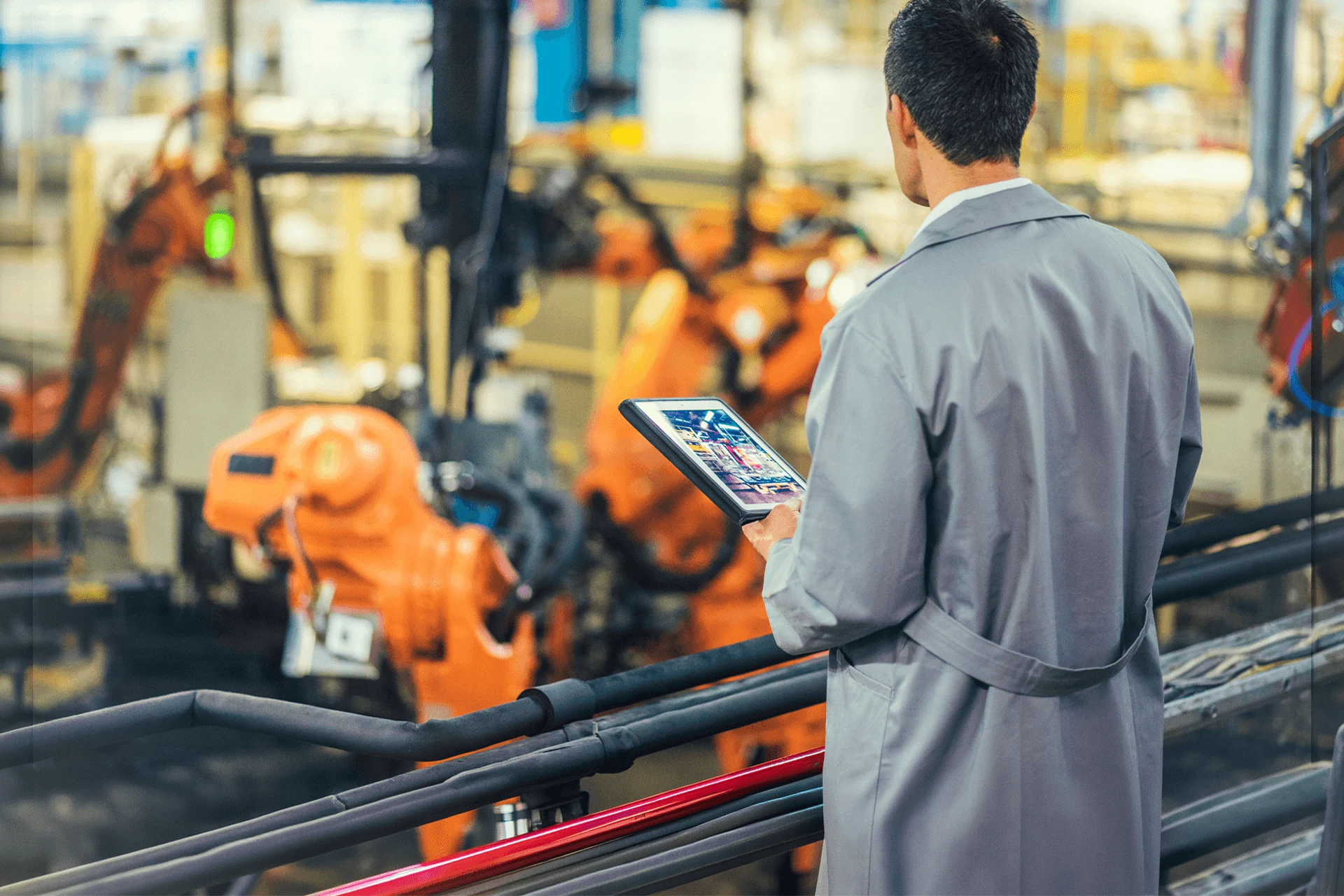
As LLMs continue to refine our language skills, the edge is no longer a chat box but how we connect with our physical world. Welcome to physical AI, a world where intelligence is not only in the cloud but also embedded in matter, motion, and mechanism.
The time for physical AI is near, just as it was for ChatGPT, but our world is not as clean and straightforward as text on a screen. It is messy, complex, and often unpredictable. To go from experiments to deployment, we need not just large datasets but also subtle and physically intelligent intelligence.
Machines that can think, decide, and act are revolutionizing many industries, redefining enterprise priorities, and taking us beyond programmed instructions into a new world called “Embodied Intelligence.”
Beyond rules: The perception-action loop
A set of rules defined the old industrial landscape, but that landscape has changed. Today, we don't only program; we teach our machines how to perceive. It is a continuous loop that gets better with every action.
The loop is a three-step process: Perceive Reason. Execute.
Perceive (sensory layer)
In this layer, systems require a nervous system built from data. It is not just vision; it is the combination of all data, ranging from LiDAR and ultrasonic sensors to high-definition cameras. The process of obtaining all of this data is slow, error-prone, and complex, yet it is the foundation of all physical security.
Reason (cognitive layer)
This is the layer in which humans, with the aid of AI, transform data into knowledge of the world. It is not just seeing something; it is knowing the height of the curb, the friction of the road, and the intentions of the person passing by.
Execute (kinetic layer)
This is the last step that uses all the data to execute movement. This is where AI becomes an actual tool, not just a talking companion.
The $60 billion revolution: Why the "backbone" matters
It is not just a revolution; it is a change in the way we think about work. In addition, the market is projected to grow to $61.19 billion by 2034. What powers this revolution is not the humanoids, the cars, or the robots; it is the "digital-physical backbone" that lies beneath the surface. This backbone is the invisible infrastructure that makes physical intelligence possible: the perception stacks that interpret raw sensor data, the simulation environments that train models before they touch the real world, the data pipelines that label millions of LiDAR and camera frames, and the real-time compute layers that translate insight into action in milliseconds. Without this foundation, even the most sophisticated robot is blind, slow, and unreliable.
Zensar Advantage: Expanding the autonomous frontier
We at Zensar create the infrastructure that enables autonomy to flourish. The automotive industry, once considered the incubator of industrial automation, has now become the ultimate testing ground for physical AI. Partnering with leaders in GPU computing and autonomous technologies, we understand that autonomy is grounded in solid ground truth.
We enable organizations to overcome the sim-to-real divide with
High-fidelity data labeling: Converting unrefined sensor information into precisely defined spaces.
Scalable perception systems: Integrating data and autonomy into one robust, intelligent architecture.
Reliability at scale: Guaranteeing physical AI in the real world is not only safe but also continuously operable.
From possible to extraordinary
While physical AI is revolutionizing autonomous vehicles, warehouses, and manufacturing, we are merely at the beginning of our journey. As we continue to develop machines that can increasingly see, hear, and act, we will soon explore new frontiers we have yet to conceive, from tiny robots in medical settings to autonomous efforts in environmental conservation. Most artificial intelligence exists in the virtual world; physical AI lives in the real world. Zensar Technologies provides high-fidelity sensory data that enables the world’s leading autonomous systems to see, think, and act with human-level accuracy. We're defining the future of embodied AI.
Are you ready to step off the screen and into reality?